A British summer garden has a particular kind of magic. Open an old wooden gate on a warm afternoon and, before you properly notice the flowers, you notice the air itself. It smells different. Softer somehow. Sweet with roses, warm earth and grass that has been left just a little longer than perhaps it should.
Then comes the colour.
Roses scrambling over old brick. Peonies bowing beneath the weight of their own blooms. Lavender spilling into pathways. Sweet peas climbing wherever they can find something willing to support them.
And beyond all that, the garden continues.
Not manicured. Not show-perfect. Not arranged as though somebody might arrive with a clipboard and begin judging the borders.
Just abundant.
Alive.
A little wild at the edges.
Perhaps I love gardens like this because they remind me of the ones I knew growing up—places where there was room to run, where flowers were allowed to wander, and where nobody seemed particularly concerned about keeping nature within its allotted borders.
Some gardens are visited. Others are quietly remembered for a lifetime.
This is one of the second kind.
Through the Garden Gate
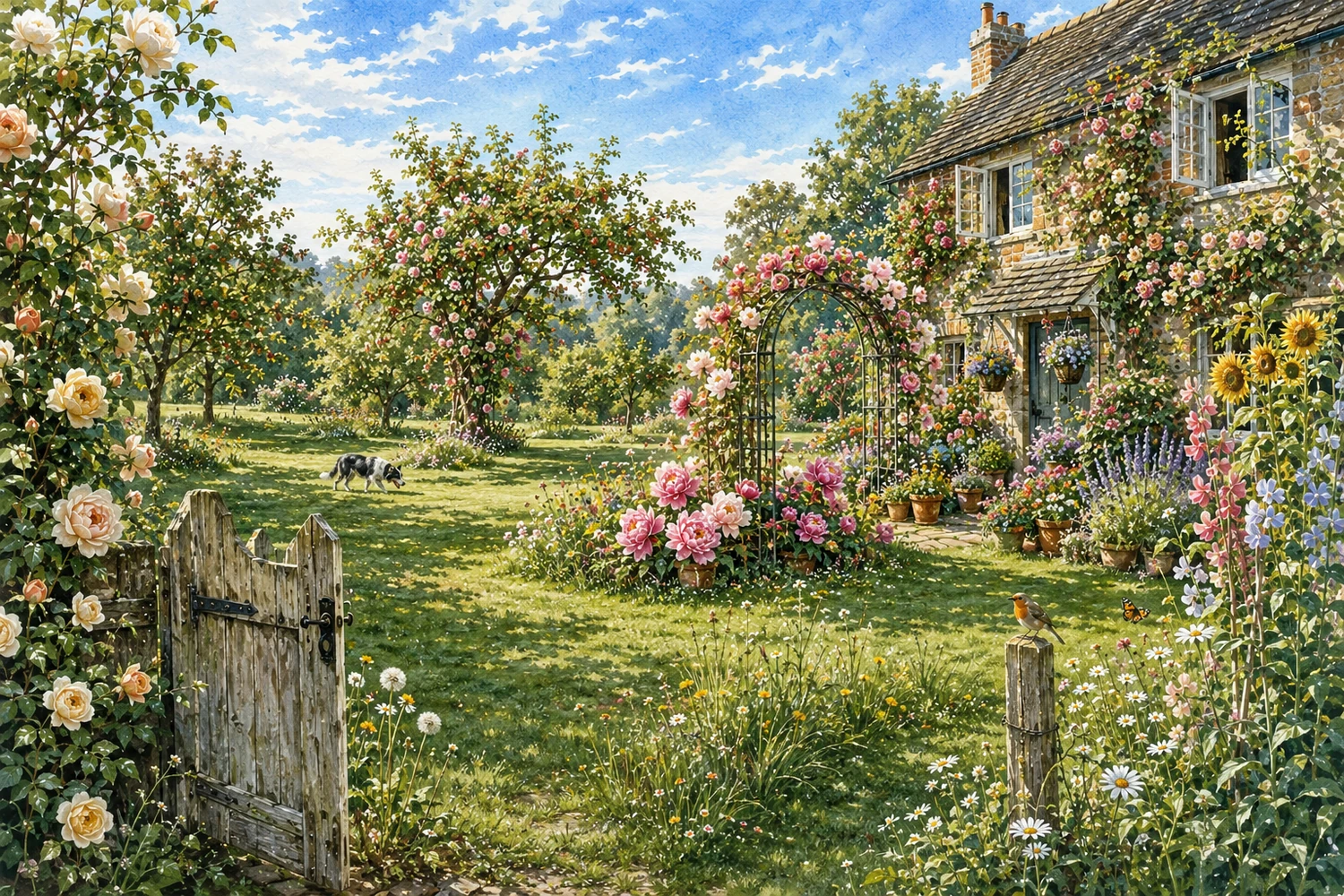
The gate is old wood, soft with age, and the roses have long since decided it belongs to them.
Just beyond it, enormous blush-pink peonies spill over a wrought-iron arch, their heavy heads bending towards anyone who passes beneath. Beyond them are only glimpses.
Long grass.
A flash of yellow.
The suggestion of an orchard in the distance.
Perhaps a sheepdog disappearing around the corner.
The garden doesn’t reveal itself all at once.
It asks you to keep walking.
And you don’t walk particularly quickly through a garden like this. Every few steps, something asks you to pause: a flower you hadn’t noticed, a bird landing surprisingly close, the fragrance changing as you move from one part of the garden to another.
There is no need to hurry.
The garden isn’t going anywhere.
Roses That Have Learned the House
Some homes aren’t decorated.
They’re embraced.
Here, climbing roses have made their way across old brick walls and around open windows, their stems following routes of their own choosing.
There are roses of almost every colour: deep crimson, palest blush, creamy white, soft apricot. Some bloom obediently beside the windows. Others have clearly abandoned any notion of boundaries and are halfway towards the roof.
Window boxes spill over with colour. Hanging baskets sway gently near the door. Terracotta pots gather wherever somebody once found an empty corner and thought, something could grow there.
On a warm afternoon, the bricks hold the heat of the sun, and the roses release that unmistakable fragrance that seems to belong only to summer.
After enough years, it’s difficult to tell whether the roses belong to the house or the house belongs to the roses.
Perhaps neither matters anymore.
The garden has quietly adopted the house as one of its own.
The Arch Where Summer Begins
The peonies deserve their own pause.
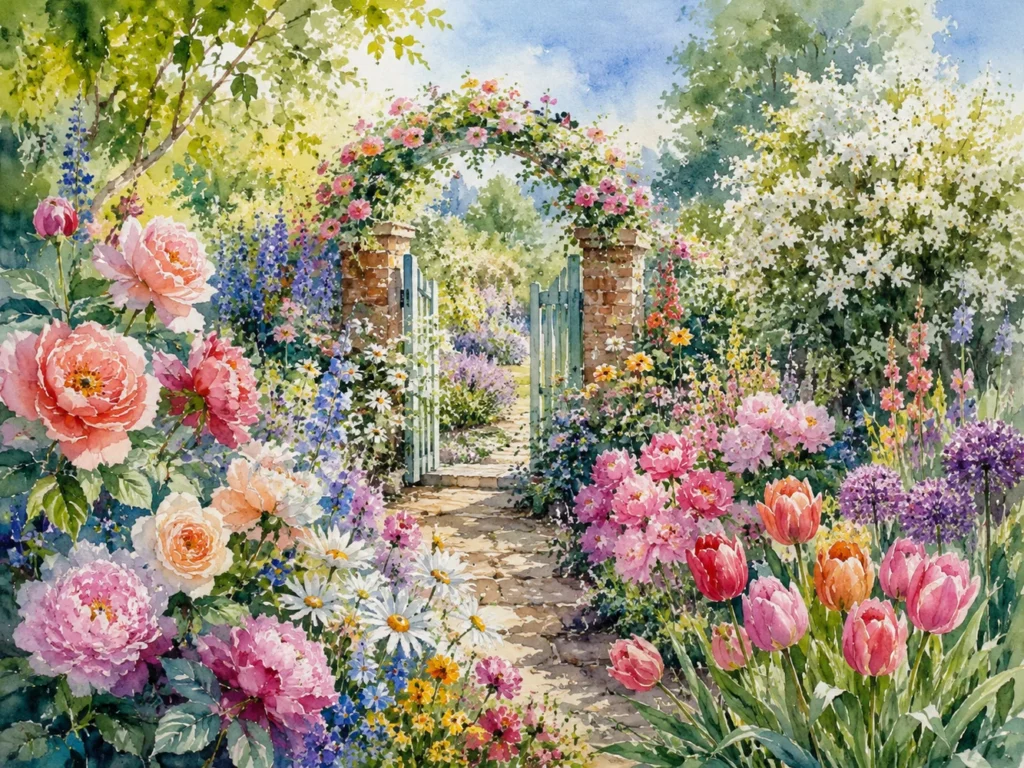
Huge, extravagant, blush-pink blooms cascade over the metal arch leading towards the meadow beyond. Some are so heavy that they seem barely able to hold themselves upright, layer upon layer of petals opening until each flower appears almost impossibly generous.
You have to walk beneath them to reach the rest of the garden.
And perhaps that’s exactly how it should be.
For a few steps, there is nothing but petals overhead, their perfume caught in the warm air and glimpses of meadow appearing between the leaves.
Peonies never stay for very long.
Perhaps that is part of their charm.
Some beauty asks us to notice it precisely because it will not wait forever.
The Meadow Never Forgot
The grass still grows as though it remembers being a meadow.
It is cut now, of course, but never into the immaculate stripes of a manicured lawn. Here and there, a patch seems to get ahead of itself. A few blades grow taller than their neighbours. Dandelions appear before anyone has thought to remove them. Buttercups, daisies and tiny wildflowers emerge in unexpected corners, little reminders of what this piece of land once was.
The old meadow hasn’t disappeared entirely.
It simply shows itself in glimpses.
A slightly wilder patch beside the orchard. A scattering of daisies near the fence. Grass moving a little more freely beneath the fruit trees. Nothing enough to make you call it a meadow anymore, but enough to know that once, it was.
Not everything beautiful needs trimming into submission.
And the garden is never really empty.
A robin lands on a fence post as though inspecting the morning’s work. Butterflies meander between flowers with no apparent destination. Bees disappear into the lavender and emerge powdered with pollen.
Every now and then, the sheepdog trots across the grass with tremendous purpose, as though conducting a particularly important inspection of the grounds, before disappearing again without explanation.
Somewhere above it all, on those slow, clear afternoons, comes another familiar sound: the distant hum of a glider tracing lazy circles through the blue.
Nothing dramatic happens.
And yet there is always something to watch.
The garden may have replaced the meadow.
But every so often, the meadow quietly reminds us that it was here first.
Branches Heavy With Summer
Around the edges of the garden, the orchard has been quietly getting on with the business of abundance.
Apple trees. Plum trees. Mulberries. Crab apples. Grape vines twisting along old supports.
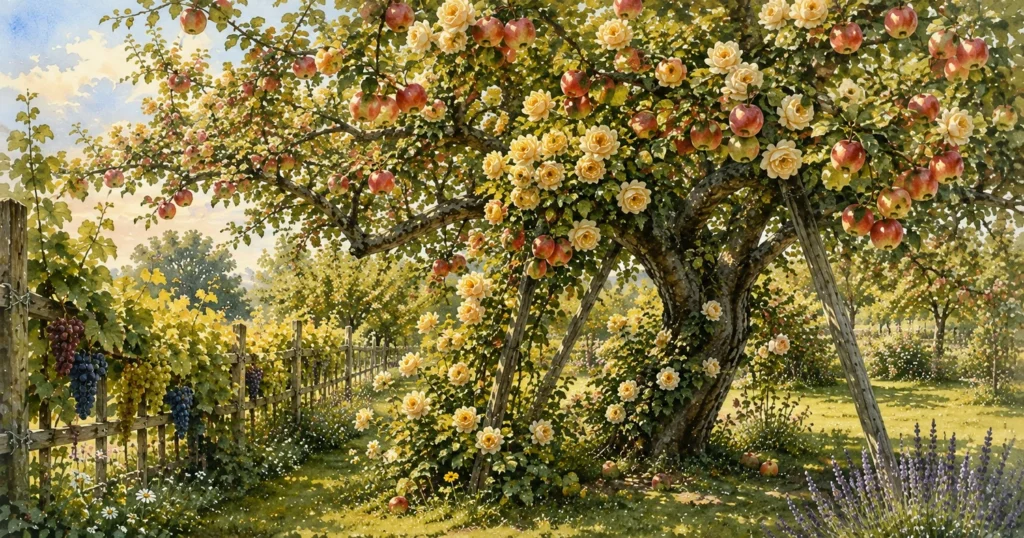
Branches bow beneath the weight of fruit, some leaning so heavily that old wooden props have been tucked beneath them for support.
There is something wonderfully generous about a fruit tree in late summer. Nobody seems particularly concerned about counting what it produces. Some fruit will be picked. Some will find its way into pies, preserves or bowls on the kitchen table. Some will be claimed by birds. And inevitably, some apples will simply fall into the grass with a soft, unexpected thud.
In one corner, an old apple tree has been almost entirely overtaken by climbing roses. They wind through its branches so freely that fruit and flowers now occupy the same canopy, and it becomes difficult to tell where the apple tree ends and the rose begins.
Abundance doesn’t apologise for itself.
And then there is the light.
Look upwards through those branches and sunlight breaks into a thousand shifting fragments—bright one moment, shadow the next, moving gently as the leaves stir in the breeze. The Japanese have a beautiful word for sunlight filtering through leaves: komorebi.
I could stand beneath a tree and watch that changing dance of light and shadow for far longer than is probably reasonable.
But that is another reflection for another day.
Lavender, Sweet Peas and the Hum of the Garden
Every few steps, the garden smells slightly different.
Lavender gives way to sweet peas. Sweet peas give way to roses. Somewhere near the kitchen door, warm herbs grow in terracotta pots, releasing their fragrance whenever a hand brushes past.
The lavender seems to hum.
Bees move steadily from flower to flower, utterly absorbed in their work. Butterflies drift through without urgency. A blackbird appears on the grass, pauses, listens, then begins searching again.
There are birds in the hedges and insects among the flowers, life happening at every height and in every corner.
The busiest places in a garden are often the quietest.
Perhaps that’s one of the strange gifts of a garden.
The closer you look, the less still it becomes.
If you love noticing flowers, changing light and the small details that make a garden feel alive, come wander a little further through my Petals & Light Pinterest board.
Sunflowers That Follow the Light
By late afternoon, the sunflowers have quietly turned.
Tall above much of the garden, their great golden faces seem to agree on where the light is coming from.
There is something almost joyful about them.
No hesitation.
No complicated deliberation.
Simply light—and the instinct to turn towards it.
Perhaps that is why sunflowers make people smile.
The Evening Watering Ritual
Eventually, the heat begins to soften.
The watering can comes out.
Pots that have spent the day drinking sunshine receive their evening water. The earth darkens as it drinks, releasing that rich, unmistakable scent of damp soil into the cooling air.
Long shadows stretch across the grass.
Drops of water catch the last of the sunlight.
Even the familiar ritual of evening watering changes during a spell of particularly warm weather — something I reflected on in When Britain Melts: The Little Rituals of a British Heatwave.
The roses seem softer now. The bees are disappearing. Birdsong changes as the day begins folding itself away.
Gardens breathe differently in the evening.
And perhaps we do too.
Tea Beneath the Apple Tree
Somewhere beneath the apple tree is a table.
Nothing elaborate.
A linen cloth. China cups. A teapot. Perhaps the remains of a Victoria sponge that was considerably larger when the afternoon began.
A book lies open, although nobody has turned a page for quite some time.
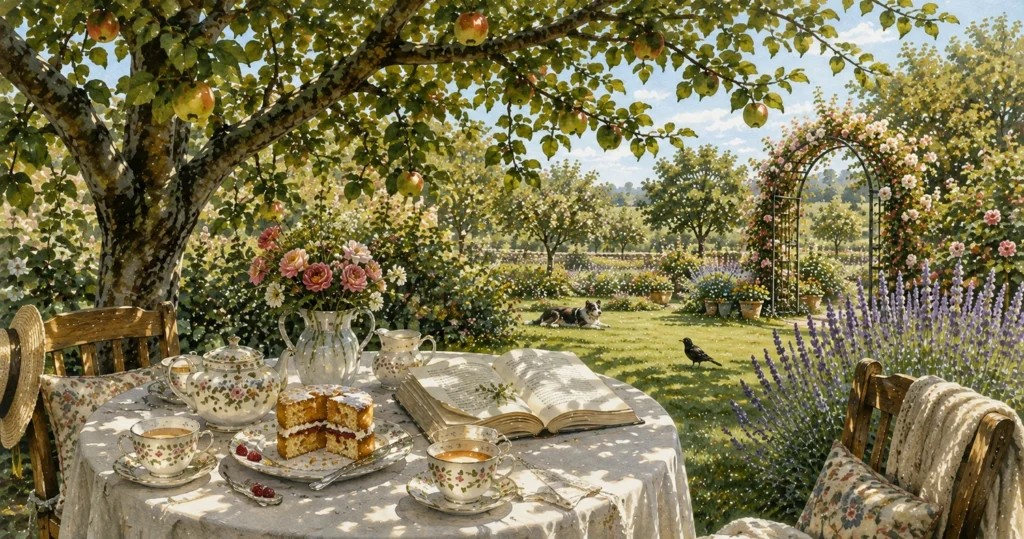
Conversation has taken over.
The breeze occasionally lifts the corner of a page. A spoon clinks against china. Somewhere in the meadow, the sheepdog has finally stopped conducting inspections and is asleep in the grass.
Nobody seems particularly interested in a screen.
Not because anyone has decided to have a digital detox.
Nobody has announced that phones are forbidden.
They simply aren’t as interesting as what is happening around us.
A blackbird hops across the lawn.
Bees are making their final visits to the lavender.
A wood pigeon calls somewhere beyond the orchard.
A glider passes overhead.
Someone pours another cup of tea.
Nothing is happening.
And absolutely everything is happening.
Some afternoons ask nothing more of us than to stay a little longer.
There is something about afternoons like these that recalls the art of slowing down — not doing nothing, but becoming present enough to notice what is already happening around us.
When Nature Becomes Enough
Perhaps that’s why gardens like this restore something in us.
They don’t demand our attention.
They simply reward it.
Surrounded by so much life—growing, singing, ripening, reaching instinctively towards the light—it becomes difficult not to recognise the generosity of God’s creation.
There is abundance everywhere, but very little hurry.
The roses climb when they are ready.
The apples ripen in their own time.
The meadow flowers appear where they will.
The birds sing without an audience.
The bees continue their work whether anyone notices them or not.
And somehow, when we spend long enough among all that quiet living, our own pace begins to change too.
We notice.
We listen.
We stay.
Perhaps the real beauty of a British summer garden has never been its perfectly arranged borders or immaculate lawns.
Perhaps it is this.
A place where nature becomes the entertainment, conversation replaces distraction, and time is measured not by clocks but by birdsong, bees and the slow journey of sunlight through the trees.
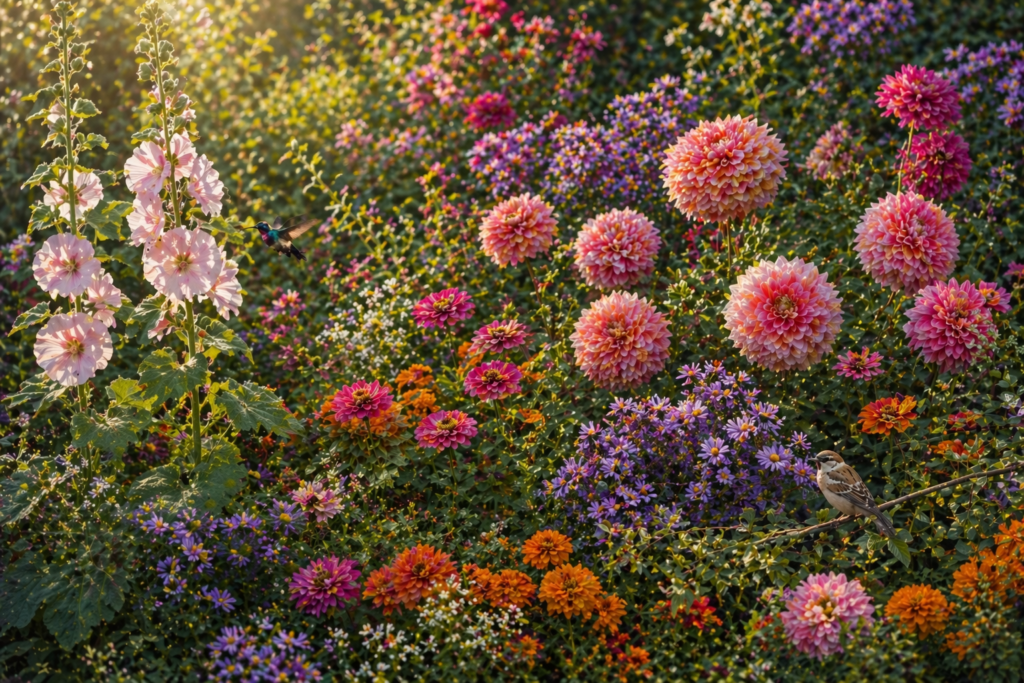
Beauty is rarely hurried.
It is planted.
Tended.
Waited for.
And then, one day, without quite noticing when it happened, it blooms.
Long after the peonies have dropped their petals, the roses have faded and the orchard has given up its final fruit, something of the garden remains.
Not only in the borders.
But in us.
Perhaps that’s what gardens have been quietly growing all along:
people who remember how to notice.
And perhaps, in noticing the beauty of the garden, we find ourselves noticing the goodness of the One who made it.
I have loved wandering through these gardens again — not only through the flowers, orchards and familiar corners, but through the memories they carried with them.
They brought back family and friends. Picnics in the garden with my sister when we were still toddlers. My grandfather gathering flowers he had grown himself and turning them into a little bouquet for my first day of school. A goat that somehow wandered in and, for a while at least, became ours. Trees climbed, knees scraped, and bare feet damp with morning dew.
They brought back Sunday afternoons after church with Mum, Dad and my sister, when the day seemed to stretch ahead of us with nowhere particular to be. My sister playing in the grass with our two little dogs. Ordinary afternoons filled with the kind of happiness no one thinks to name while they are living it.
Perhaps that is what gardens hold so beautifully.
Not only flowers and fruit, but fragments of our lives.
The people who sat beside us. The games we played. The small kindnesses we did not yet understand were becoming memories.
And perhaps, when we slow down long enough to notice a garden, we sometimes find ourselves walking gently back through those old moments too.
Perhaps there is a garden tucked away in your memories too.
If there is, I hope you find a little time to wander back through it. Remember what grew there. Who sat beside you. The sounds you heard, the flowers you loved, the ordinary afternoons you didn’t yet know you would one day miss.
Sometimes slowing down isn’t only about noticing what is around us now.
Sometimes it gives us time to gently pick through the old memories too — and to give thanks for the people, places and moments God has allowed to become part of our story.