An Invitation to Notice
Something Has Changed
You notice it without deciding to.
The small signs of autumn are there. A morning feels slightly different against your skin than it did last week. Not cold. Not even cool, necessarily. Just fractionally other — the way a room feels different when someone has moved a single piece of furniture and you can’t immediately say what.
Nothing announces itself. There is no first leaf falling in slow motion, no obliging gust of wind to make the point for you. Just a small, private sense of something, gone again almost as soon as you’ve registered it.
We spent the last piece here staying with summer, deliberately not looking ahead. This one is different.
Now we can look. Carefully — not for the postcard, but for the almost-things.
The ones easy to miss because they don’t ask to be seen.
The Small Signs
Once you start looking, you find you were already halfway to noticing.
The light falls at a different angle through the kitchen window than it did a month ago — not dramatically, just enough that the shadow of the chair has shifted a hand’s width across the floor. A market stall that sold nothing but stone fruit for ten weeks has quietly added something new to the crate at the front. A bird that has called from the same tree all summer sounds slightly more urgent, or slightly less, or has simply gone somewhere else and left a silence you don’t notice until you’re standing in it.
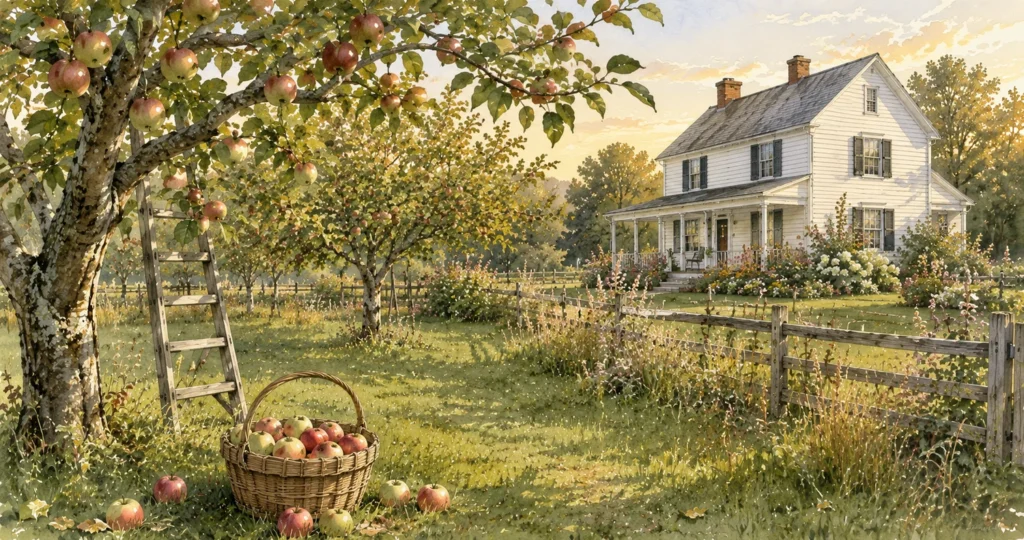
There’s a flower head in the garden that has stopped being a flower and started being a seed — dry, papery, faintly rattling in the wind if you touch it. The first piece of fruit lies on the ground beneath the tree rather than on it. A plant that has looked triumphant for weeks has begun, almost apologetically, to tire.
If you live somewhere the heat has been fierce, the sign might be gentler than any of this: an evening that is still hot, technically, but no longer punishing.
The air lets you outside half an hour earlier than it did in July. That’s the whole sign. That’s enough.
None of this is a catalogue to tick off. These are not the ten things to look for before autumn officially begins. They are simply the kinds of things we begin to see when we’ve been looking at the same corner of the world for long enough.
And Then You Know
No single sign of autumn sign proves anything.
One shifted shadow could be a cloud. One early chill in the morning could be nothing more than a passing front. A piece of fruit on the ground may simply have fallen.
But a few days later, the shadow has moved again, in the same direction. There is more fruit beneath the tree. The grass has begun to look a shade less green at the edges. Perhaps the evening has shortened enough for you to notice.
And somewhere in the accumulation, you know.
Not because the calendar told you so, but because enough small, separately unremarkable things have begun pointing the same way.
This is how many of us actually recognise a season changing: through the slow arithmetic of small observations, added together without our quite noticing we were counting.
Autumn, Wherever You Are

Here is the thing worth saying plainly: autumn does not look the same everywhere, nor does it arrive everywhere at once.
Where I am, it may announce itself through colour — a hedge starting to rust at the edges, a lawn losing its confidence. Elsewhere, colour may have very little to do with it. The change might appear at harvest, in fields being cleared or a market suddenly full of things that weren’t there in August. It might come with rain after months of dry weather, or become visible simply in the shortening of the evening — the same clock everyone in that place has learned, almost without noticing, to trust.
And in some of the hottest places, where summer has been less a pleasure than something to be endured, the first signs of autumn may be almost imperceptible. The heat simply begins loosening its grip by degrees. An evening outside becomes possible again.
Elsewhere in the world, of course, the signs are pointing towards spring instead — another reminder that the seasons have never moved to one universal calendar.
The signs are not the same everywhere. The invitation to notice them is.
Autumn is larger than its postcard.
The orange leaves, pumpkins on doorsteps and that particular slant of golden light are real and lovely. I am rather fond of all three. But they are only one expression of a season changing. Autumn might be grass turning a shade less green than it was, rain on ground that has been dry for months, or simply the first evening in a long while when the air feels kind again.
You don’t need my season to recognise your own.
It Doesn’t Have to Be Spectacular
Most of the signs are small.
It might be one flower past its best rather than a whole bed of them, or five minutes less light in the evening than there was last week. A cobweb holds the morning dew a little longer than it used to. The patch of shade beside the house feels cooler than it did. Washing on the line takes an extra half hour to dry.
None of this needs to be dramatic to be true.
We tend to imagine seasonal change as a single decisive moment — the day it finally happens. In reality, it is usually a long succession of tiny adjustments, many of which would be entirely unremarkable if we hadn’t been looking at the same place for weeks beforehand.
The account of Elijah in 1 Kings 19:11–12 gives us another way of thinking about this. God’s revelation did not come to him in the great wind, the earthquake or the fire. It came afterwards, in what the King James Bible calls a still small voice.
“And after the fire a still small voice.”
— 1 Kings 19:12
Perhaps a season changing can feel a little like that. We keep watching for the loud things — the tree that turns overnight, the morning that announces itself — when more often the change comes quietly, in details we could easily pass by.
Not everything worth noticing arrives with a spectacle.
The Practice of Paying Attention
There is something worth sitting with here, and it isn’t really about autumn at all.
To notice that a shadow has moved a hand’s width, you have to remember where it was. To notice a bird has gone quiet, you have to have known it was there, singing, in the first place. To notice that a plant looks slightly tired this week, you have to have looked at it enough times before now to know what not tired looked like.
You have to have looked yesterday to know that something is different today.
That’s not really a skill for identifying seasons. It’s closer to intimacy — the particular, patient kind that comes from paying attention to the same place, over and over, until its small changes become visible to you.
A stranger walking through your garden wouldn’t see any of this. They’d see a garden. You’d see the specific week it started, quietly, to become something else.
Perhaps that’s what paying attention gives us. Not vigilance. Not a checklist. Just the familiarity that comes from having looked before, so that looking again means something.
Go and See
So here is the invitation, and it isn’t a list.
Not ten signs of autumn to find this week. Not a scavenger hunt with a correct answer at the end. Just this: go and look at your own patch of earth, wherever it happens to be, and see what has changed.
It may be colour. It may be rain, or the particular quiet of a garden that hummed with insects all summer and has gone still, or an evening that feels different the moment you step outside. It may be nothing you would have thought to look for.
Look once.
Then look again.
The small signs have a way of appearing when we know what yesterday looked like.
Stay a little longer
If something here gave you reason to pause, notice or look again, there’s more quiet encouragement, Scripture, seasonal beauty and everyday noticing across Mel Curates.
Follow along on
And if this reflection made you think of someone, you’re always welcome to share it.