I’ll admit it—I didn’t expect a World Cup football tournament to make me think about God.
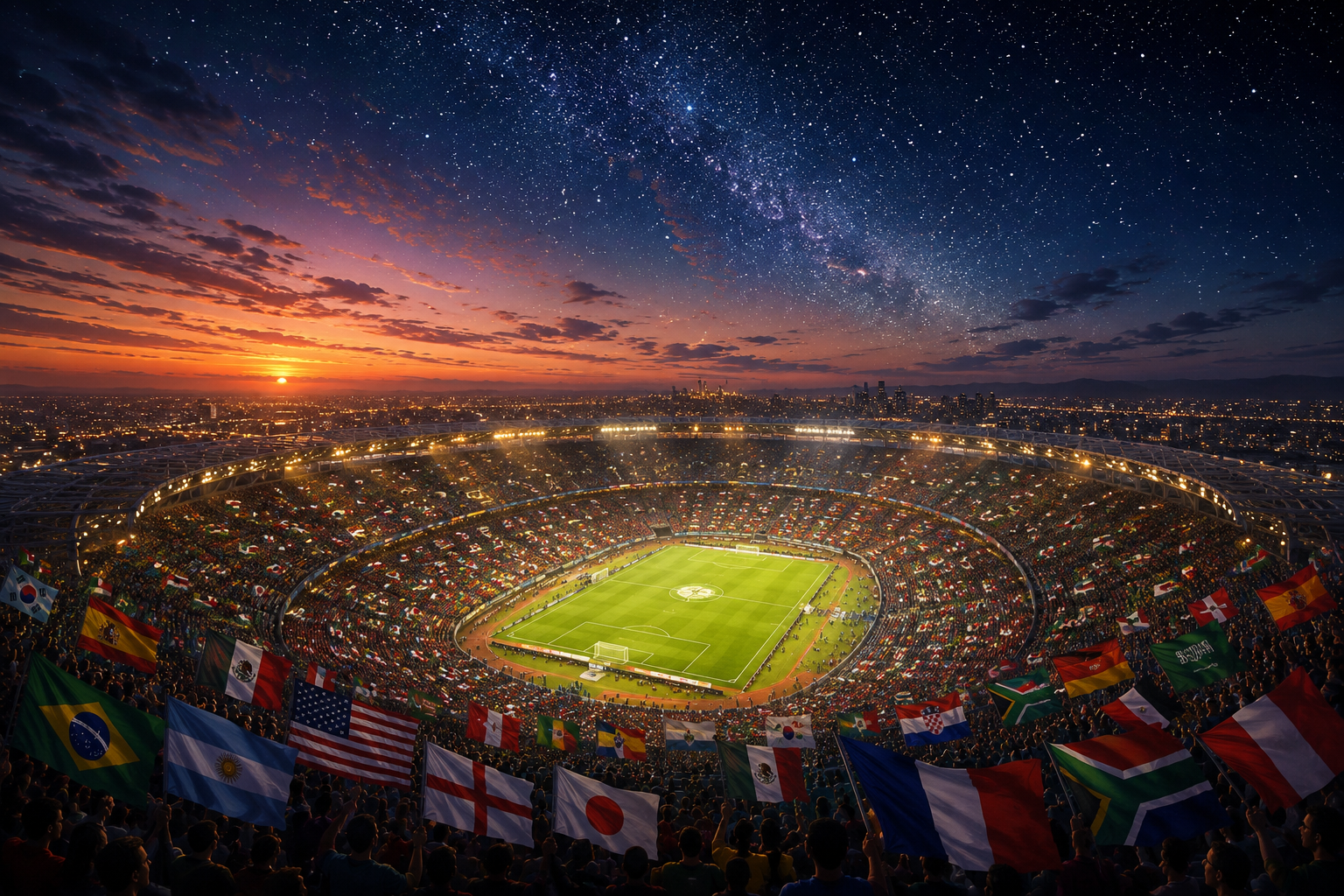
But somewhere between the national anthems, the underdog victories, and the sight of thousands of people wrapped in different flags yet singing with the same excitement, I found myself paying attention to something beyond the scoreline.
For a few weeks, the world pauses. Conversations begin with last night’s match. Families stay up late. Airports, cafés, living rooms and city squares become places where strangers suddenly have something in common. It struck me that there are very few moments in modern life when so many people are looking towards the same event at the same time.
That isn’t just a sporting phenomenon.
It’s a deeply human one.
And it made me wonder what it says about the way God made us.
Every Nation, Tribe and Tongue
This year’s tournament is the first to welcome forty-eight nations. More flags. More languages. More stories. More people finding themselves represented on football’s biggest stage.
Watching supporters celebrate their countries reminded me of John’s vision in Revelation, where he sees “a great multitude that no one could count, from every nation, tribe, people and language” standing before the throne of God (Revelation 7:9).
The World Cup is not a picture of heaven. It is far too imperfect for that.
But perhaps it echoes something that runs deep within us.
There is something profoundly moving about seeing people from every corner of the earth gathered together. Perhaps that longing for a world brought together rather than pulled apart isn’t simply cultural. Perhaps it reflects the heart of the God who created every nation and is drawing people to Himself from every one of them.
I’ve seen glimpses of that same picture much closer to home.
Walk into certain churches in larger, multicultural cities and you’ll often find something remarkably similar.
Different accents rising in the same prayers.
Different cultures gathered around the same Communion table.
People who might never have crossed paths anywhere else now standing side by side, singing the same hymns and confessing the same hope.
It isn’t always effortless. Bringing together different cultures, traditions and personalities requires humility, patience and love. Like any family, the Church learns to grow together over time.
But when it does, even imperfectly, it offers a quiet glimpse of something far greater.
A congregation that reflects the diversity of the community around it becomes more than a gathering of believers. It becomes a living reminder that God’s kingdom has always been bigger than borders, languages or cultures—a small echo of Revelation 7:9, lived out each week in ordinary church buildings long before it is fulfilled before the throne.
Why We Love an Underdog
Every tournament has a team that nobody expected to succeed.
The smaller nation.
The overlooked squad.
The players whose names commentators struggle to pronounce until suddenly everyone knows them.
I’ve noticed how quickly our hearts turn towards them. Even supporters with no connection to that country often find themselves quietly hoping they keep winning.
Why?
Perhaps because somewhere inside us we recognise that greatness isn’t always measured by reputation.
Scripture never suggests that God automatically sides with whoever is losing. Yet again and again He chooses to work through unlikely people so that His strength—not human achievement—receives the glory.
A shepherd boy stood before a giant.
A reluctant leader faced Pharaoh.
Fishermen carried the gospel across the world.
God has often delighted in accomplishing extraordinary things through ordinary people.
Maybe that’s one reason underdog stories continue to resonate so deeply with us.
Hope Wears Many Colours
Before a single ball is kicked, every nation arrives believing.
Some believe they’ll lift the trophy.
Others simply hope to make history by winning one match.
Hope fills stadiums long before victory does.
It strikes me that hope is one of the great gifts God has woven into humanity. We keep planting gardens after difficult winters. We keep praying through unanswered seasons. We keep beginning again.
Hope is rarely logical.
It is simply part of what keeps us moving forward.
Christian hope goes even deeper. It isn’t confidence that life will unfold exactly as we want, but confidence that God remains faithful whatever the outcome.
Perhaps that’s why hope feels so natural to us.
We were created by the Author of hope Himself.
Waiting Shapes Us
World Cups come around only once every four years.
Children become adults between tournaments.
Players reach their peak—or miss it entirely.
Some receive one opportunity to stand on football’s biggest stage and never another.
The waiting is part of the story.
Our lives often feel the same.
There are seasons when answers seem delayed, prayers remain unanswered, and very little appears to change. Yet Scripture repeatedly reminds us that waiting is not empty space. God often does His deepest work in places where we can see the least.
“Those who wait on the Lord shall renew their strength” (Isaiah 40:31).
Waiting rarely feels productive.
But it is often profoundly formative.
Joy and Grief Can Share the Same Field
One of the most striking moments after a knockout match isn’t the winning goal.
It’s the final whistle.
On one side of the pitch, players collapse in tears.
A few metres away, others embrace in celebration.
The same field somehow holds heartbreak and jubilation at exactly the same time.
Life often feels like that.
While one family welcomes a new child, another says goodbye to someone they love.
One friend receives wonderful news while another quietly carries disappointment.
Paul’s instruction to “rejoice with those who rejoice; mourn with those who mourn” (Romans 12:15) sounds simple until we have to live it.
The World Cup doesn’t resolve that tension.
It simply reminds us that both joy and sorrow belong to the human story, and compassion makes room for both.
Unity Doesn’t Require Uniformity
One of my favourite sights isn’t actually on the pitch.
It’s in the stands.
Brazilian supporters arrive with colour and music.
Japanese fans bring remarkable order.
African nations dance.
Europeans sing.
South Americans celebrate with infectious passion.
Nobody is asked to become someone else in order to belong.
Their differences don’t weaken the occasion.
They enrich it.
Paul used similar language when describing the Church as one body with many parts (1 Corinthians 12). Unity was never meant to erase personality, culture or gifting. It was always intended to bring diverse people together under one Lord.
Real unity isn’t everyone becoming the same.
It’s many distinct lives finding a common purpose.
A Larger Invitation
With more nations competing than ever before, this tournament feels like a wider table with more seats.
That image stayed with me.
Throughout Scripture, God’s kingdom is often described as an invitation rather than an exclusive gathering. Again and again, the invitation extends further than people expect. The guest list keeps growing. Grace keeps making room.
Jesus tells a parable in which the master sends his servants out again and again so that his house may be filled (Luke 14:23).
The invitation was always larger than people imagined.
Perhaps that’s why global events like the World Cup capture our imagination so deeply.
For a brief moment, they awaken something ancient within us—a longing to belong, to gather, to celebrate alongside people who are different from us yet somehow connected to us.
Eventually the stadium lights dim.
The songs fade.
The flags are folded away.
Life returns to its ordinary rhythms.
But the longing remains.
And perhaps that longing is quietly pointing beyond the tournament itself, towards the day when every nation, every language and every people will gather, not around a football pitch, but around the throne of the One who first invited us all.
If you’ve enjoyed reflecting on faith through the lens of everyday life, you may also enjoy 🌿 The Circle of Faith: A Gentle Shift That Changes How You Live, where I explore how a simple change in perspective can quietly reshape the way we see God, ourselves and the world around us.