There are some things about a British summer that quietly find their way into my thoughts every July.
The scent of freshly cut grass drifting in through an open window. Long evenings that seem reluctant to end. Strawberries that somehow taste sweeter in the sunshine.
And then there’s Wimbledon.
Whenever I think of July in Britain, Wimbledon is never far behind. Not simply because of the tennis, but because of everything that quietly gathers around it.
For two weeks every summer, Britain seems to settle into a gentler rhythm. Offices fall strangely quiet around lunchtime. Televisions appear in staff rooms. Pubs put the match on with the sound down and the radio commentary up. Even people who couldn’t name a single player the other fifty weeks of the year find themselves quietly wondering whether the rain will arrive before the fourth set.
Held each July at the All England Club since 1877, Wimbledon is the oldest tennis tournament in the world. Yet somewhere over more than a century, it quietly stopped being just a sporting event and became something closer to a national mood.
Wimbledon doesn’t ask to be followed closely. It simply asks to be present in the background of July—and Britain, almost without noticing, always says yes.
A Very British Kind of Hush
There is a specific quiet that only exists on Centre Court.
It falls the moment a serve is tossed—a whole stadium of people holding their breath in unison.
For a few seconds, thousands of people become astonishingly still together—a rare kind of collective silence that feels almost impossible anywhere else.
Then comes the clean, satisfying thwack of racket meeting ball, followed by warm, restrained applause.
It is a hush unlike any other in British sport. Not tense exactly, but attentive. Reverent, almost.
Even the umpire’s voice, calling the score in that familiar clipped, unhurried cadence, has become part of the atmosphere as much as the tennis itself.
The Sound of Wimbledon
Close your eyes, and Wimbledon is instantly recognisable.
A freshly opened tube of tennis balls.
The soft squeak of trainers changing direction on the grass.
The clean, rhythmic thwack of racket meeting ball.
An umpire calmly calling the score in that familiar measured cadence.
Polite applause rising and falling without ever becoming a roar.
Somewhere overhead, the distant hum of a helicopter drifting across a warm London afternoon.
Even the rain has its own soundtrack, tapping gently against the Centre Court roof before the match quietly resumes.
Wimbledon isn’t only watched. It’s heard.
Strawberries, Cream and a Jug of Pimm’s
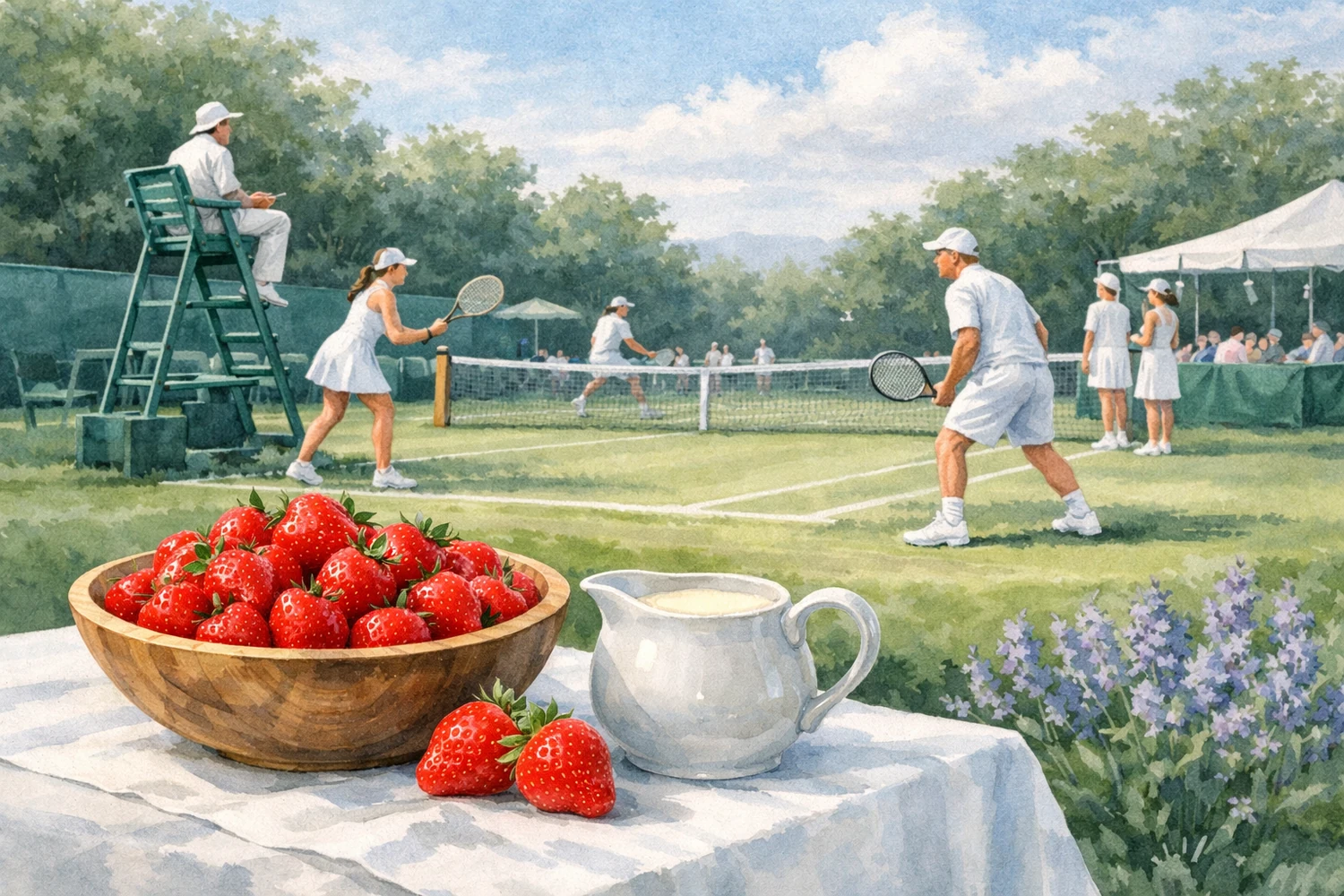
If Wimbledon had a flavour, almost everyone would agree on it instantly: strawberries and cream, eaten from a little cardboard punnet with a small wooden fork, ideally in the sunshine.
It isn’t really about the fruit.
It’s one of those small rituals that has become inseparable from the Championships themselves. Whether you’re there in person or watching from home, strawberries and cream somehow feel as essential to Wimbledon as the tennis itself.
Alongside them comes another unmistakable taste of the fortnight: a chilled jug of Pimm’s poured generously over ice with cucumber, strawberries, orange and fresh mint. Condensation trickles down the side of the glass as spectators settle into deckchairs, picnic blankets or Centre Court seats, hoping the sunshine lasts just a little longer.
Together, strawberries and cream and a glass of Pimm’s have become part of the sensory language of Wimbledon—a tradition as familiar as the first serve on Centre Court.
All in White: Wimbledon’s Unmistakable Dress Code
Wimbledon is famous for enforcing one of the strictest dress codes in world sport.
Every player must wear almost entirely white—a rule taken seriously enough that even the colour of undergarments has, at times, been regulated.
The tradition dates back to Victorian etiquette, when white clothing was thought to conceal perspiration more discreetly during physical activity.
Today, it gives Wimbledon a visual identity unlike any other. Against the rich green of the grass courts, the sea of white clothing has become instantly recognisable. Elegant. Timeless. Unmistakably Wimbledon.
Rain Stops Play (and Britain Simply Carries On)
No British summer tradition would be complete without a passing shower, and Wimbledon has learned never to argue with the weather.
When rain interrupts play, the covers appear with practised efficiency, umbrellas quietly unfold, and conversation simply carries on.
Since the retractable roof arrived on Centre Court, the interruptions matter a little less than they once did, but on the outside courts the old ritual remains unchanged.
Britain doesn’t stop for the rain. It simply adjusts, waits if it must, and then carries on in its most inimitable British manner.
The Queue: Camping Out for Centre Court
Officially known simply as The Queue, with a capital Q, this is one of the last remaining ways to buy same-day tickets for Wimbledon—and people take it remarkably seriously.
Some arrive the evening before with tents, folding chairs and picnic supplies, settling into Wimbledon Park for what has become a tradition in its own right. There is a code of conduct, a quiet sense of fairness and, before long, a surprising camaraderie among strangers who know they’re all waiting for the same thing.
In an age of online booking systems and virtual waiting rooms, The Queue feels refreshingly old-fashioned. It asks for patience rather than speed, and rewards those willing to embrace the experience as much as the destination.
For many, spending a night in The Queue is not simply the way to watch Wimbledon.
It is part of what it means to do Wimbledon.
The Royal Box: Ceremony in the Stands
High above Centre Court sits one of the tournament’s most recognisable traditions: the Royal Box.
Members of the Royal Family take their seats alongside distinguished guests, sporting legends, artists, authors and public figures from around the world. Yet, somehow, nothing about it feels ostentatious.
Like so much else at Wimbledon, the ceremony is understated.
Respect is shown quietly. Applause remains measured. Tradition is honoured without needing to announce itself.
Even the familiar television moments—cameras gently panning across famous faces before returning to the match—feel less like celebrity spotting and more like another thread in the rich tapestry of the Championships.
Prestige, at Wimbledon, never needs to raise its voice.
Henman Hill and Murray Mound: Wimbledon Without a Ticket
Not everyone has a ticket to Centre Court, and Wimbledon has long had a wonderfully British answer to that.
Outside the grounds, thousands gather on a grassy slope to watch the biggest matches on a giant screen.
Over the years it has affectionately become known as Henman Hill, Murray Mound and, depending on the nation’s latest tennis hero, acquired a few other nicknames besides.
Blankets are spread across the grass. Strawberries are shared. Glasses of Pimm’s are raised. Friends cheer complete strangers as though they’ve known them for years.
Watching Wimbledon from the hill somehow captures the spirit of the Championships just as beautifully as sitting inside the famous arena.
Perhaps even more so.
More Than a Tennis Tournament
Wimbledon is, of course, about who wins—a fortnight of remarkable sporting drama with a trophy waiting at the end.
Yet somehow the memories that linger are often quieter than the tennis itself.
The hush before a serve.
The unmistakable sound of racket meeting ball.
Strawberries eaten in the sunshine.
A queue that becomes part of the adventure.
Rain that briefly interrupts before everyone simply carries on.
For many households, Wimbledon is less something that’s actively watched than something that’s simply on—gently accompanying lunches, afternoon tea and long July evenings as life carries on around it.
Perhaps that’s why Wimbledon feels larger than sport.
For two gentle weeks every July, it reminds Britain how to pause together.
The scores will eventually fade from memory. Another champion will lift the trophy. Centre Court will fall silent until next summer.
Yet what lingers is often something much simpler: applause carried on warm air, hopeful glances towards gathering clouds, and the quiet comfort of knowing that, for a little while at least, Britain has once again fallen beautifully, unmistakably quiet.
Perhaps that’s the real championship Wimbledon wins every summer—not simply a trophy, but Britain’s attention, gently held for two remarkable weeks.
Wimbledon may have drawn to a close for another year, but the memories it stirs are only one chapter of a British summer. I hope you’ve enjoyed reading these reflections as much as I’ve enjoyed writing them. There are many more summer memories, traditions and quiet moments still to come, and I look forward to sharing them with you in our Quintessential British July collection.