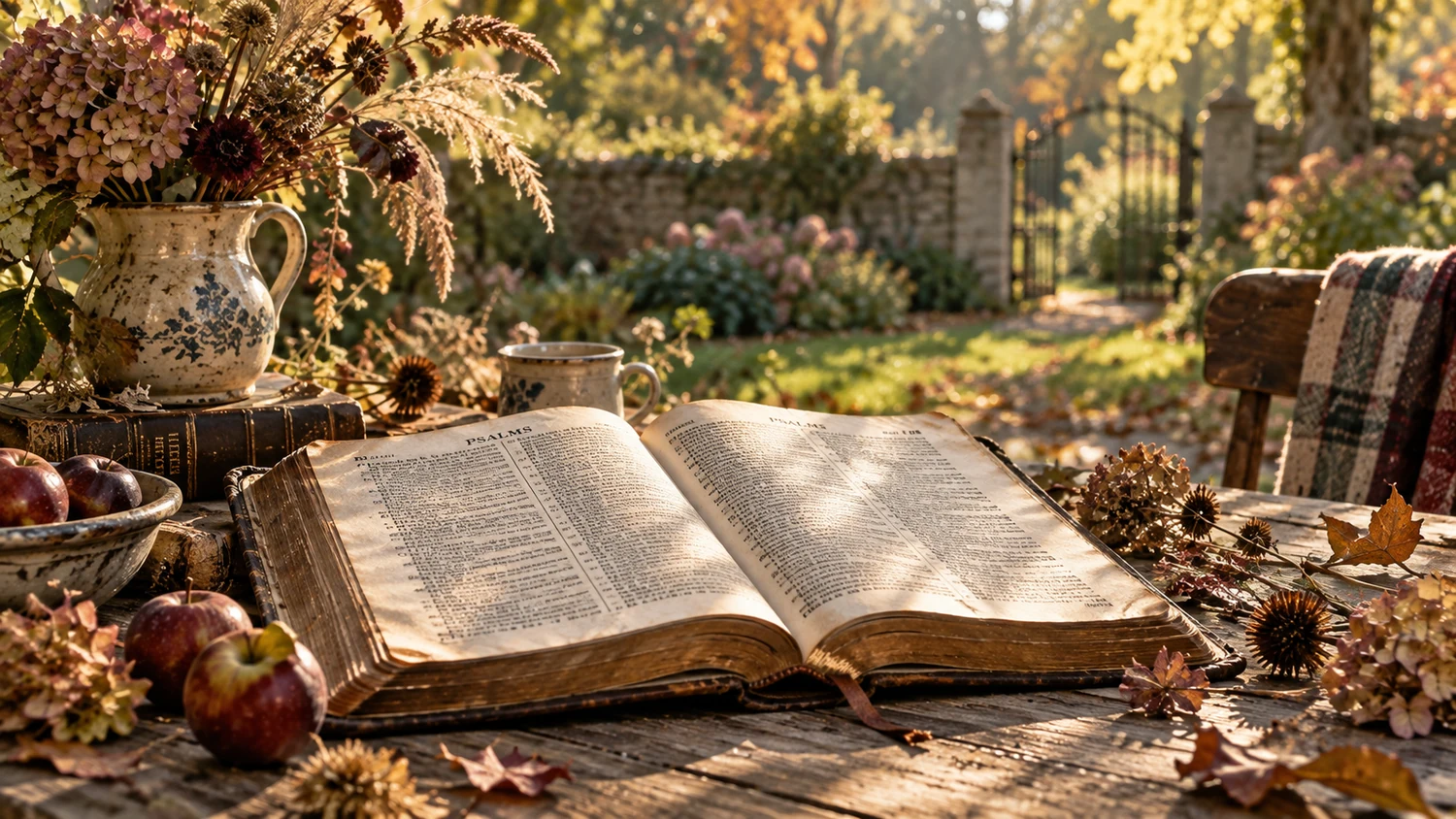
There is something about autumn that makes change easier to see. It may begin quietly: a cooler morning, the light fading a little earlier, the first leaf turning at the edge of a tree. Gardens that seemed endlessly green only weeks ago begin to soften into gold, russet and brown. Some things are ripening. Others are finishing. The whole landscape seems to be reminding us that one season is giving way to another.
Our own seasons are not always so easy to recognise.
Sometimes change is welcome. Sometimes we have prayed for it. At other times, we would gladly keep things exactly as they are.
Perhaps that is one reason autumn can be such a meaningful season in which to return to Scripture.
The Unchanging God of Shifting Seasons: Inspiring Bible Verses for Autumn
The Bible does not promise us a life untouched by change. Instead, it continually directs us towards the faithfulness of God within it.
These Bible verses for autumn are gathered around some of the things this season invites us to consider: change, trust, fruitfulness, gratitude, waiting, rest and hope.
You might read them all at once, choose one section for the season you are currently walking through, or simply carry one verse with you into the week ahead.
When Life Is Changing
Autumn makes change visible.
A tree that was green becomes gold. A garden that was abundant begins to empty. Days shorten. Familiar routines return or shift.
Our lives have seasons too, although their beginnings and endings are rarely marked neatly on a calendar.
Some changes are exciting: a new home, new work, a new relationship, a long-awaited opportunity. Others arrive through disappointment, loss, uncertainty or circumstances we would never have chosen.
Scripture does not ask us to pretend that all change feels good. It gives us something steadier to hold onto.
Ecclesiastes 3:1
“To every thing there is a season, and a time to every purpose under the heaven:”
— Ecclesiastes 3:1, KJV
There is a tenderness in remembering that we are not required to remain in one season forever.
Some seasons are for beginning. Some are for building. Some are for waiting. Some are for gathering what has grown.
And some are simply seasons we must walk through faithfully until they change again.
Hebrews 13:8
“Jesus Christ the same yesterday, and to day, and for ever.”
— Hebrews 13:8, KJV
The seasons change.
Jesus does not.
When circumstances feel unfamiliar, this simple truth can become an anchor: the One in whom we place our trust has not become less faithful because our surroundings have changed.
Malachi 3:6
“For I am the LORD, I change not…”
— Malachi 3:6, KJV
There is great comfort in those few words.
We cannot always predict what a new season will bring, but our confidence does not have to rest in our ability to predict it.
It can rest in God.
Autumn reflection: What is changing in your life at the moment? Before asking yourself how you will manage everything ahead, spend a moment remembering what you already know to be true about God.
Trusting God and Letting Go
We often speak about autumn as a season of letting go.
It is a beautiful image, but real-life surrender is rarely as effortless as a leaf drifting from a branch.
Letting go may mean releasing our preferred timetable. It may mean accepting that we cannot control another person’s choices. It can mean placing a worry repeatedly into God’s hands because, by lunchtime, we have quietly picked it up again.
Trust is not indifference. It is choosing where we will place the weight of what we cannot carry alone.
Proverbs 3:5–6
“Trust in the LORD with all thine heart; and lean not unto thine own understanding.
In all thy ways acknowledge him, and he shall direct thy paths.”
— Proverbs 3:5–6, KJV
We naturally want understanding first.
We want the map, the explanation and preferably a glimpse of how everything will work out.
Yet these verses reverse the order.
Trust comes before complete understanding.
There will be seasons when we cannot see far enough ahead to know where a path leads. We can still take the next faithful step.
Psalm 55:22
“Cast thy burden upon the LORD, and he shall sustain thee: he shall never suffer the righteous to be moved.”
— Psalm 55:22, KJV
Notice that the invitation is not to pretend there is no burden.
There is something heavy.
There is simply somewhere to take it.
1 Peter 5:7
“Casting all your care upon him; for he careth for you.”
— 1 Peter 5:7, KJV
We sometimes imagine that only the largest concerns belong in prayer.
But “all your care” leaves room for the smaller things too: tomorrow’s conversation, the decision we keep reconsidering, the family concern sitting at the back of our mind, the uncertainty we cannot resolve tonight.
A question to carry into autumn:
What am I trying to control that I could instead place into God’s hands?
Harvest and Fruitfulness
Autumn is naturally associated with harvest.
Fields are gathered. Orchards bear fruit. Gardens offer the last of what has been growing through the warmer months.
But Scripture gives fruitfulness a richer meaning than simply having something impressive to show for our effort.
A fruitful life is not necessarily a busy one.
Sometimes the most significant growth is happening where very few people can see it.
Galatians 6:9
“And let us not be weary in well doing: for in due season we shall reap, if we faint not.”
— Galatians 6:9, KJV
“In due season” matters.
Not everything we plant produces immediate evidence of growth.
A kindness may seem unnoticed. A prayer may appear unanswered. Faithful work may continue for a long time before anything seems to come from it.
Scripture encourages us not to mistake not yet for never.
John 15:5
“I am the vine, ye are the branches: He that abideth in me, and I in Him, the same bringeth forth much fruit: for without me ye can do nothing.”
— John 15:5, KJV
Fruitfulness begins with abiding.
That is very different from the pressure to constantly produce.
Before asking, “What have I achieved this season?” there may be a better question: Have I remained close to Jesus?
Galatians 5:22–23
“But the fruit of the Spirit is love, joy, peace, longsuffering, gentleness, goodness, faith,
Meekness, temperance: against such there is no law.”
— Galatians 5:22–23, KJV
Perhaps this is one of the most freeing ways to think about harvest.
We tend to count visible things. God may be growing patience.
We count accomplishments. He may be cultivating gentleness.
We look for evidence that we are moving quickly. He may be teaching us peace.
Not all fruitfulness looks like productivity.
As autumn arrives, consider what God may have been growing within you, not simply what you have produced around you.
Autumn Gratitude
Harvest naturally turns our attention towards what has been gathered.
Gratitude asks us to notice what has already been given.
It does not require us to declare that everything in life is perfect. Gratitude and difficulty can exist in the same day.
It simply teaches us not to overlook goodness because we have become accustomed to receiving it.
Psalm 107:1
“O give thanks unto the LORD, for he is good: for his mercy endureth for ever.”
— Psalm 107:1, KJV
Our gratitude begins with who God is.
Circumstances fluctuate. His goodness does not.
James 1:17
“Every good gift and every perfect gift is from above, and cometh down from the Father of lights…”
— James 1:17, KJV
Some gifts announce themselves.
Others are so ordinary that we barely register them anymore.
A meal on the table. Someone who calls. Strength for today’s work. A quiet hour. Rain on a dry garden. Laughter from another room. A prayer answered so gradually that we almost forgot we once prayed it.
Autumn is a lovely time to begin taking note again.
1 Thessalonians 5:18
“In every thing give thanks: for this is the will of God in Christ Jesus concerning you.”
— 1 Thessalonians 5:18, KJV
“In every thing” can be difficult to understand from our own limited perspective. Why give thanks in a season we would never have chosen?
Scripture reminds us that testing is not always without purpose. Just as gold is refined through fire, there are seasons through which God refines us—strengthening our faith, revealing what needs to change and drawing us into deeper dependence upon Him. We may not understand the purpose while we are walking through it, and gratitude does not require us to call what is painful good.
It does, however, allow us to trust that God can still be at work within it.
Even within a difficult season, we can continue looking for His presence, His provision and His mercy—and trust that what is being refined in us may only become clear with time.
A Simple Autumn Gratitude Practice
At the end of the day, write down three things:
One thing I received.
One thing I noticed.
One thing for which I thanked God.
They do not need to be profound.
The practice is simply an invitation to pay attention.
Seasons of Waiting
Autumn is not only a season of harvest.
It is also a season of slowing.
Plants die back. Seeds disappear beneath soil. Trees lose the leaves that once made them appear full.
To an impatient eye, very little seems to be happening.
Our spiritual lives can contain seasons like this too.
We pray, wait, continue and wonder why there is so little to see.
Scripture reminds us that waiting is not the same as abandonment.
Psalm 27:14
“Wait on the LORD: be of good courage, and he shall strengthen thine heart: wait, I say, on the LORD.”
— Psalm 27:14, KJV
Waiting requires courage precisely because we do not yet have the outcome.
But we do not wait alone.
Lamentations 3:25–26
“The LORD is good unto them that wait for him, to the soul that seeketh him.
It is good that a man should both hope and quietly wait for the salvation of the LORD.”
— Lamentations 3:25–26, KJV
There is a difference between passive resignation and hopeful waiting.
Biblical waiting still seeks God.
It still hopes.
It still trusts that silence does not mean He is absent.
Not every quiet season is an empty one. It is an opportunity to listen.
There may be things God is doing that have not yet broken the surface.
Trading Striving for Surrender
As autumn evenings draw in, life itself can seem to invite a little more shelter.
Lights go on earlier. Doors close against cooler air. Home begins to feel different.
It is easy to turn rest into an aesthetic—blankets, candles, warm drinks and an early night.
Those things can be lovely.
But biblical rest reaches deeper.
It asks whether we believe we are held by God even when we stop striving.
Matthew 11:28
“Come unto me, all ye that labour and are heavy laden, and I will give you rest.”
— Matthew 11:28, KJV
Jesus’ invitation is not merely to stop working.
It is to come to Him.
Psalm 23:1–3
“The LORD is my shepherd; I shall not want.
He maketh me to lie down in green pastures: he leadeth me beside the still waters.
He restoreth my soul…”
— Psalm 23:1–3, KJV
There are times when restoration requires us to stop treating exhaustion as evidence of faithfulness.
We are creatures with limits.
Rest acknowledges them.
Exodus 33:14
“And he said, My presence shall go with thee, and I will give thee rest.”
— Exodus 33:14, KJV
The deepest rest is not found in arranging circumstances perfectly.
It is found in God’s presence.
Hope in the Season Ahead
Autumn teaches us that endings and beginnings often overlap.
One season is fading while another is already approaching.
Faith does not require us to know exactly what comes next. Christian hope is not confidence that every circumstance will unfold according to our preferred plan.
Our hope is rooted in God.
Lamentations 3:22–23
“It is of the LORD’S mercies that we are not consumed, because his compassions fail not.
They are new every morning: great is thy faithfulness.”
— Lamentations 3:22–23, KJV
New mercy does not wait for a new year, a new season or a better set of circumstances.
It arrives with the morning.
Psalm 31:24
“Be of good courage, and he shall strengthen your heart, all ye that hope in the LORD.”
— Psalm 31:24, KJV
Hope is not pretending we have no questions.
It is deciding where those questions will live.
Romans 15:13
“Now the God of hope fill you with all joy and peace in believing, that ye may abound in hope, through the power of the Holy Ghost.”
— Romans 15:13, KJV
Autumn may remind us to notice what is changing. Scripture reminds us where to look while it does.
A Simple Autumn Scripture Practice
You do not need an elaborate Bible-study plan to spend more time in Scripture this autumn.
Choose one verse from this collection and stay with it for a week.
Read It
Read the verse slowly rather than rushing on to the next passage.
Write It
Copy it into a journal or notebook. Writing by hand often makes us notice words we skim when reading.
Notice It
Choose one word or phrase that keeps drawing your attention.
Ask why.
Pray It
Allow the verse to shape a simple prayer.
If you are reading about trust, tell God where trust feels difficult. If the verse speaks about gratitude, name what you are grateful for. If it speaks about waiting, bring Him the thing for which you are still waiting.
Carry It
Return to the verse during the week.
You might keep it beside your desk, inside your Bible, on your phone or somewhere you will naturally see it.
The goal is not to collect as many verses as possible.
It is to give Scripture room to remain with you.
What to Carry, What to Leave Behind
Perhaps we do not need to hurry through a changing season.
We can notice it.
Notice what has ripened.
Give thanks for what has been given.
Release what cannot be carried forward.
Rest where rest is needed.
Wait without assuming that nothing is happening.
And when the path ahead looks different from the one behind us, remember that the God who walked with us there will still be God here.
The season changes. God does not. He forever remains faithful.
This post focuses on the visual shifts of fall, but God’s unchanging presence anchors us all year round. You can read more about navigating the changing landscapes of the soul in my main article, Seasons of Faith.
Stay a little longer
If something here gave you reason to pause, notice or look again, there’s more quiet encouragement, Scripture, seasonal beauty and everyday noticing across Mel Curates.
Follow along on
And if this reflection made you think of someone, you’re always welcome to share it.